
 Authorized distributor of Emerson automation fluid-control valve products for the lithium battery industry|
 Partner of Hamilton (Switzerland) process sensors (electrodes) for the lithium battery industry
Composite-Material Valves (Non-Metallic, Corrosion-Resistant)
Composite-material valve solutions for strongly corrosive duties in lithium battery cathode precursor, lithium extraction and hydrometallurgy, meeting both metallic-foreign-object control and media corrosion / erosion requirements.
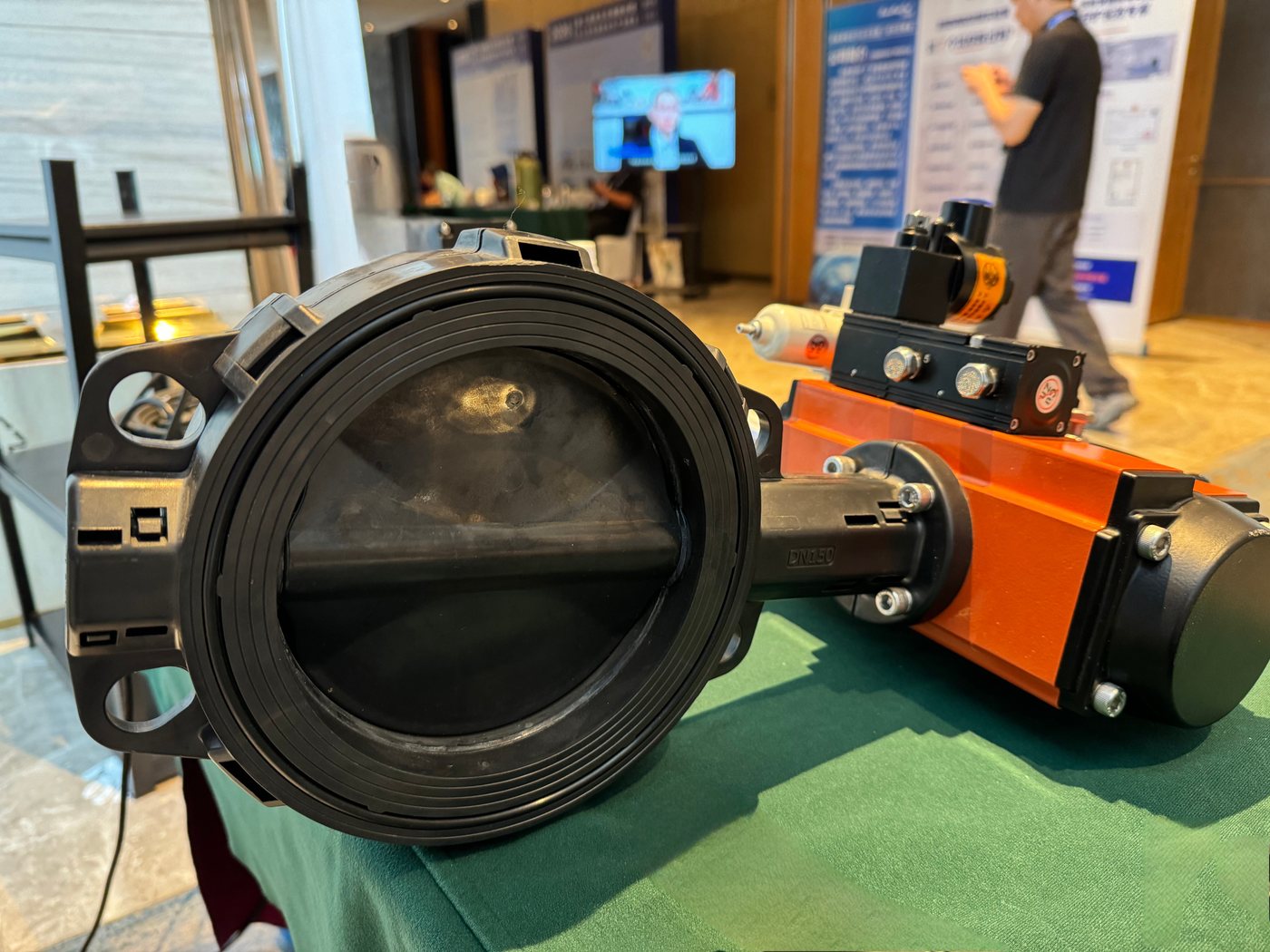
Emerson KEYSTONE COMPOSEAL XP1600 / XP1620 Series
For highly severe duties such as lithium battery cathode precursor reactors, strongly acidic leaching in hydrometallurgical lithium extraction, and fluoride-containing media, Flowtech primarily recommends the Emerson KEYSTONE COMPOSEAL XP1600 / XP1620 composite-material valves. Molded in one piece from high-strength engineering composite material, the wetted parts are completely free of any metal contact, cutting off at the source the precipitation path of magnetic foreign objects (MI) such as iron, copper and zinc. Combining excellent mechanical strength with acid/alkali and erosion resistance, they resolve the field pain points of traditional PTFE-lined valves (blistering and wear) and ordinary plastic valves (creep and deformation).
Why the lithium battery field needs non-metallic valves
Lithium battery materials tolerate metallic foreign objects only at the ppm level. The stem and seat of a stainless-steel valve continuously release iron, chromium and nickel ions under media erosion, and these impurities ultimately enter the cathode material, affecting electrochemical performance and safety.
The second problem with metal valves is corrosion and erosion: hydrometallurgy and precursor synthesis use large volumes of strong acids, fluoride-containing media and solids-laden slurries, which dramatically shorten metal valve body life — frequent replacements and heavy downtime losses.
Composite-material valves solve both problems at once: the wetted parts contain no metal, and the material itself is corrosion-resistant.
Applicability and limits
| Duty | Applicability |
|---|---|
| Ambient to medium-high temperature acids and alkalis | ✅ Core scenario |
| Solids-laden slurries, erosion-prone | ✅ Flow velocity and selection need attention |
| Fluoride-containing media | ✅ Material grade must be specified |
| High temperature and high pressure | ❌ |
| High cycling frequency | ⚠️ Actuator and valve type need evaluation |
The advantages of composite materials: corrosion resistance and zero metal contamination combined with strength and hardness beyond conventional plastics, at a lighter weight.
Engineering data
- Users served to date: 80 companies
- Valves delivered to date: 30500 sets
- Projects delivered: 500+
Parameters to confirm before selection
- Medium composition and concentration (especially fluoride and chlorine content)
- Temperature, pressure, flow velocity
- Pipe diameter and connection standard
- Operation mode (manual / pneumatic / electric) and cycling frequency
- Any special requirements such as anti-static or fire-safe